

Introducing Concurrent Reviews: Continued-Stay Authorizations Built Into the Managed Care Agent


TL;DR:
Concurrent Reviews tracks every next review date, builds an editable clinical justification for continued skilled care from data already in your EHR, flags when level of care or medications should change, and gets the organized package to the payer by portal or eFax, all in the same place the prior authorization was run.
The authorization came through. The clock is already running.
A managed care patient admits, the prior authorization comes back approved, and for a moment the hard part feels done.
Then the first review date lands on the calendar.
Coverage has to be re-justified every few days for the entire length of the stay, and every review is a chance for something to slip.
For many facilities, that work still lives in a spreadsheet, or a standing report that's already stale by the time anyone opens it. Deadlines get tracked in one person's inbox and memory. And payers don't make it easy: some want updates before the weekend, others on Monday. Some want them a day ahead of the next review date, others that morning only. Reviews slip through easily.
Tracking is only the beginning. Every review also needs a written clinical justification, and the evidence is split across systems: clinical documentation in one EHR, therapy notes in another. Each one gets written from scratch, sentence by sentence, under time pressure.
That's why we built Concurrent Reviews, now available as standard within the Managed Care Agent (MCA). When we launched MCA, it automated the front door: the prior authorization that gets a patient admitted. Concurrent Reviews carries it through the stay, keeping coverage intact, at the reimbursement level that matches the patient's acuity.
"I love that I can filter all of my buildings and see what's not submitted and what's in review, so I know exactly what I'm waiting on. And the week ahead is all right there."
How it works
One live view of every active authorization
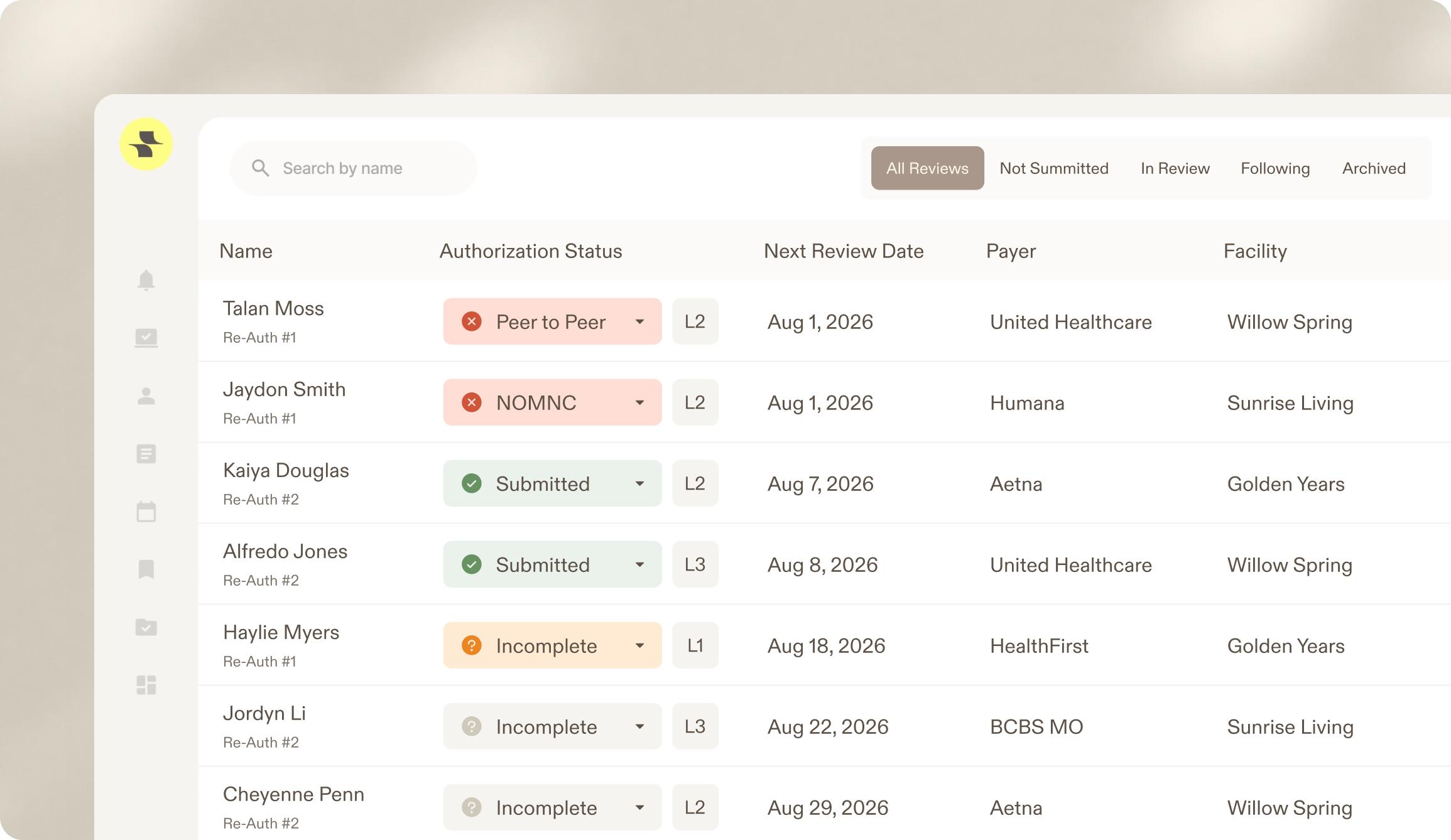
The Concurrent Reviews table replaces standing authorization reports and spreadsheets with one list that's always current. Each row shows the patient, facility, payer, submission method, authorization status, and next review date, so the state of every active authorization is visible without running anything.
The list is built to be worked, not just read. Statuses update as reviews move from not submitted through in review, the list can be searched and filtered, and filter views can be saved, so a regional team and a single building can each see exactly the slice they own.
Next review dates, tracked automatically
A live view is only as good as the dates inside it. Concurrent Reviews captures each next review date from the payer's approval, keeps it in sync, and flags it as the deadline approaches, so nothing depends on someone remembering to check.
This is where cadence differences stop being a liability. A payer expecting an update in 3 days and a payer expecting one in 5 or more sit in the same list, each on its own clock, tracked centrally instead of per person.
A justification, drafted and waiting
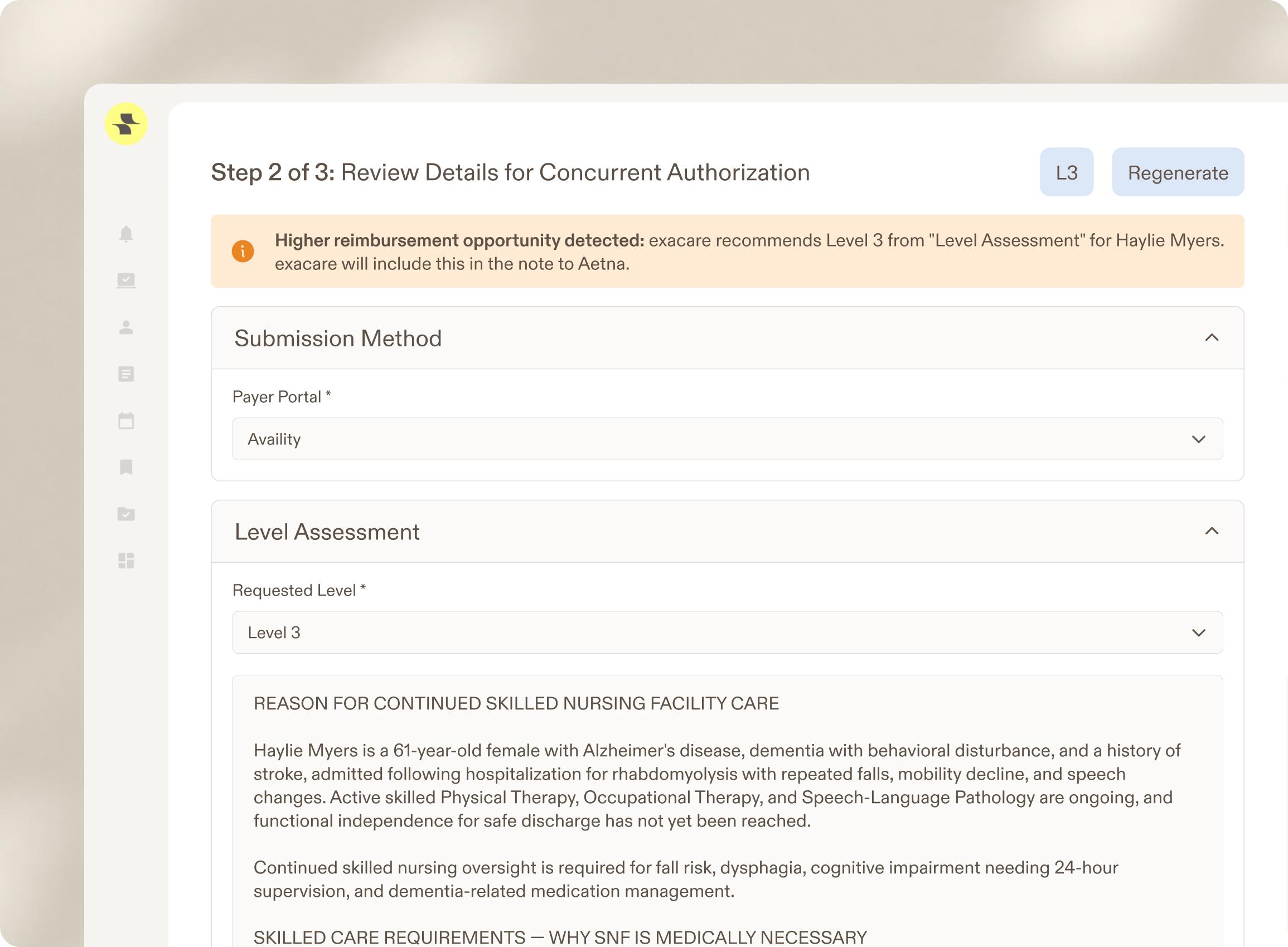
Building a clinical justification takes time, 30–60 minutes per patient when done manually, and most of it goes to assembling documentation rather than understanding where the patient actually stands. Concurrent Reviews drafts it ahead of time: a roughly two-page, organized, editable justification for continued skilled care, built automatically from the clinical evidence already in your EHRs. By the time the team logs in on the morning of a review, the draft is waiting. If new documentation comes in, the draft can be regenerated on demand.
National Health Care Associates (NHCA), one of the first to go live, is the early proof. In their first week live, the team generated 100 patient clinical reports. They're now generating over 100 a day, most of them drafted automatically ahead of the review.
Written the way payers actually evaluate
The clinical rationale is the hardest part of a concurrent review. Under time pressure, clinicians default to describing patient deficits, how sick the patient is, what they can't do. It's a natural instinct, but it's not what payers are looking for: they want to see the skilled services being delivered and the path back to the patient's prior level of function.
Concurrent Reviews builds every justification around that framing from the start, so the case reads the way the reviewer on the other end will evaluate it, and the clinician's job becomes refining a draft instead of constructing one from scratch.
Flags for level changes and medication carve-outs
A patient's acuity on day one isn't their acuity on day ten. Conditions change, therapy plans change, medications get added, and if the authorization doesn't keep pace, the facility delivers more care than it's being paid for.
Concurrent Reviews watches for those moments. It flags when a patient's acuity supports a higher level of care, when contracted therapy minutes aren't being delivered, and when a newly added medication needs a carve-out, so those conversations with the payer happen during the stay, while there's still time to act on them.
The goal is simple: reimbursement that matches the care actually being delivered, not just the level set at admission.
Gather the packet, then submit
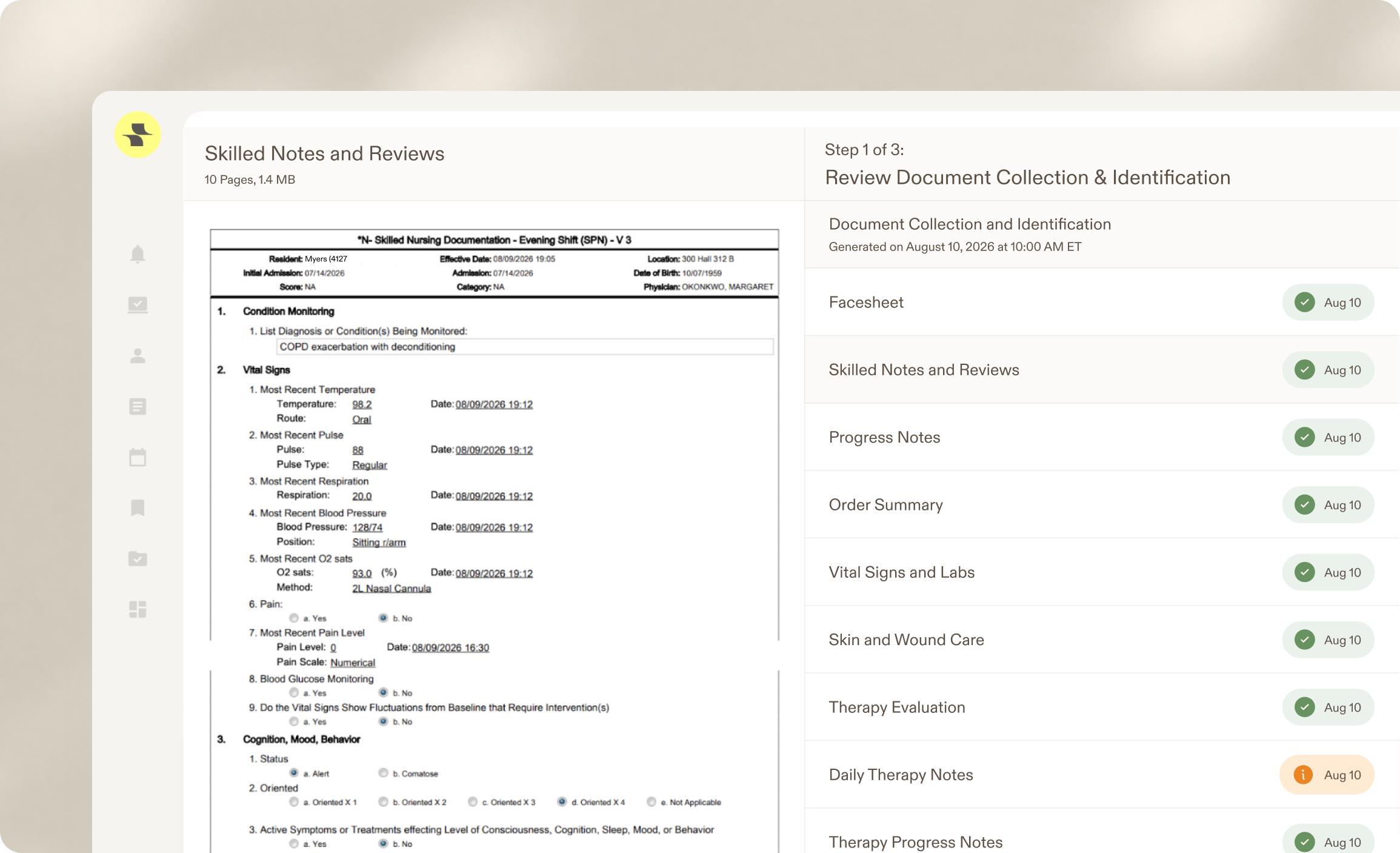
A justification is only part of what the payer needs. The rest is the supporting evidence: the clinical documentation that backs up every claim the justification makes.
Concurrent Reviews assembles that package automatically, pulling the relevant clinical evidence together and identifying what's missing. If a piece of the record lives somewhere else, a document from an outside provider, a note that hasn't synced, it can be uploaded manually to complete the packet.
When the packet is ready, it goes to the payer without leaving exacare ai: through supported payer portals, with submission status tracked along the way, or via eFax for payers that don't operate a portal. Either way, no printing, no separate fax machine, no logging into a portal to re-key what's already in the system.
A clinician reviews everything before it goes anywhere
Two questions come up with any AI in a payer-facing workflow: does this replace the managed care team, and does it send things without anyone looking?
No, and no. Concurrent Reviews is built around the opposite assumption, that a clinician reviews payer-facing content before it's submitted. Every summary is editable. The evidence behind each draft is curated, and quality guards run on the generated output. Nothing moves to a payer until someone on the team decides it should.
The AI does the assembling. The clinicians do the judging.
Where it lives
Managed care now has its own home in exacare ai: an Authorizations section in the left-hand navigation, with Prior Authorizations and Concurrent Reviews side by side.
For teams already running prior authorizations through exacare ai, Concurrent Reviews picks up exactly where that workflow leaves off. And for teams whose prior authorizations are initiated by the hospital, Concurrent Reviews works just the same: once the approval exists, the review cycle can be tracked and managed there.
What customers are saying
Before launch, the team at NHCA named the clinical rationale as their biggest pain point. Here's how they describe it now:
"The rationale for medical necessity is one of the most impactful parts of a concurrent review, and it's time consuming to find the right verbiage. Our clinicians use Concurrent Reviews as a starting point and framework that we personalize for every patient's needs and the care provided. It has been a game changer."
In their first 3 weeks on Concurrent Reviews, NHCA has generated 750 clinical justifications across 42 facilities and 450 patients.
What's coming
Concurrent Reviews covers continued-stay authorizations, but the authorization lifecycle doesn't end there. The same infrastructure is built to carry the workflows that follow: Notices of Medicare Non-Coverage and appeals, ACO and IPA updates, and Additional Document Requests (ADRs). Those are the use cases we're focused on building out this quarter.
The data foundation is expanding too, with deeper EHR connectivity bringing full therapy context into every case.
How to get started
If you're an existing Managed Care Agent customer, your Operations lead can walk you through what Concurrent Reviews could look like for your team.
If you're not yet running managed care through exacare ai and want to see how the Managed Care Agent handles the full authorization lifecycle, from prior authorization through the last concurrent review, contact our sales team to learn more.
With Concurrent Reviews, keeping patients authorized becomes one more workflow your team can stop running manually, without giving up review of a single word that goes to a payer.
Related reading
Want to see how operators are using exacare ai across admissions and managed care? Explore how Ignite Medical Resorts centralized admissions and managed care with exacare ai, or read how Exceptional Living Centers drove 32% more admissions and 26% more accepted referrals.
Share







Move your team forward
Move your team forward