

What Software Do Skilled Nursing Facilities Use? A Practical Guide


TL;DR
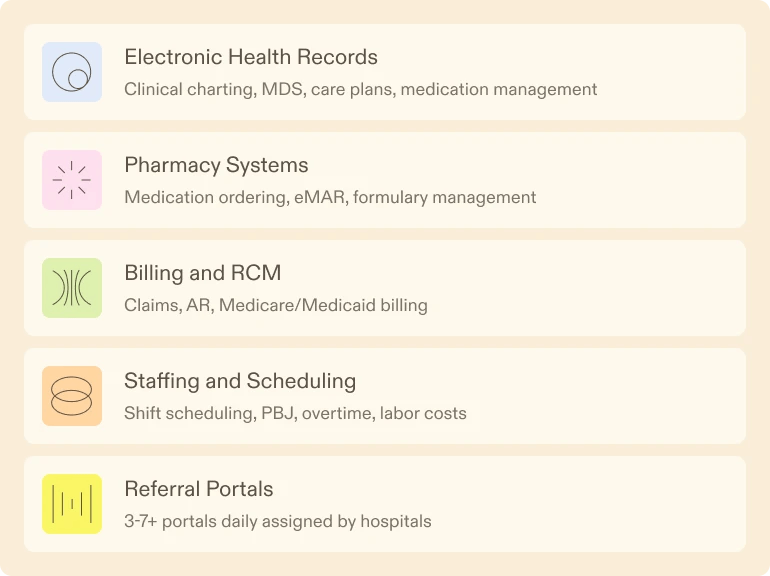
- Most SNFs operate on five core software categories. EHR (dominated by PointClickCare), pharmacy systems, billing/RCM, staffing and scheduling, and referral portals (most operators manage 3-7+ simultaneously).
- The biggest technology gap in skilled nursing is the operational layer between these systems: admissions and referral management, census and bed management, managed care authorization, and cross-building communication. Most facilities still run these workflows manually.
- AI-powered intake and admissions tools like exacare ai fill this gap, with top performers making referral decisions in 11 minutes or less (vs. 45+ minutes manually), census increases of up to 43%, and $140K+ in recovered reimbursement from improved prior authorization processes.
Most skilled nursing facilities run on somewhere between six and ten different software systems on any given day. The EHR handles clinical documentation. A separate system manages pharmacy. Another handles billing. Staffing has its own platform. And then there are the referral portals (four, five, sometimes ten of them), each requiring its own login, each feeding information that someone on the admissions team has to manually pull together before they can make a decision on a patient.
If you work in a SNF, none of this is news. But if you're trying to understand the full picture of how technology actually operates inside skilled nursing, whether you're evaluating new tools, onboarding into a leadership role, or trying to figure out why your team spends so much time toggling between systems, it helps to see the landscape laid out clearly.
The five core systems: what every SNF runs on
These are the foundational platforms. Nearly every skilled nursing facility in the country operates on some combination of the following.
1. Electronic health records (EHR)
The EHR is the backbone of the building. Clinical charting, MDS assessments, care plans, medication management, physician orders, and patient progress tracking: it all lives here. Most facilities spend the majority of their software time inside the EHR, and for good reason. It's where patient care is documented, where healthcare professionals spend most of their day, and where compliance is maintained. It is a SNF’s system of record.
The dominant EHRs include:
- PointClickCare dominates the SNF market, running in roughly 85% of facilities
- MatrixCare holds a meaningful share, particularly among operators with mixed portfolios or senior living communities
- Netsmart (myUnity) serves a smaller segment, often in organizations that span home health or behavioral health alongside skilled nursing
- WellSky and Brightree are more common on the home health and hospice side
Switching EHRs is one of the most disruptive things an operator can do. Most organizations choose one and build everything around it.
2. Pharmacy systems
Pharmacy platforms handle medication ordering, eMAR integration, and formulary management. They're tightly coupled with the EHR. In most facilities, the pharmacy system and the EHR need seamless data exchange for medication reconciliation and administration records to work properly.
Common platforms include:
- PharMerica
- Omnicare
- Drug pricing databases like First Databank (FDB), which feed cost data into clinical and financial workflows
- QuickMAR handles medication administration records at some facilities
The pharmacy layer doesn't get much attention in technology conversations, but when it breaks, or when pricing data is inaccurate, the downstream effects on admissions decisions and reimbursement can be significant.
3. Billing and revenue cycle management
Claims submission, accounts receivable, Medicare and Medicaid billing, and collections: the back-office systems that maintain a facility's financial health.
- In many SNFs, billing is handled through modules built into the EHR. PointClickCare and MatrixCare both offer revenue cycle tools as part of their platforms.
- Some operators use standalone RCM platforms like Waystar, particularly when they need more sophisticated claims management or eligibility verification across multiple payers.
4. Staffing and scheduling
Shift scheduling, PBJ (Payroll-Based Journal) reporting, overtime tracking, and labor cost management. Platforms like Smartlinx and OnShift (now part of ShiftKey) are built specifically for the long-term care workforce.
This layer has a direct impact on CMS staffing ratings and regulatory compliance, which is why it's typically a standalone system rather than a feature inside the EHR.
5. Referral and e-referral portals
This is where fragmentation becomes most visible.
Skilled nursing facilities receive patient referrals through electronic portals operated by hospitals, health systems, and care coordination platforms. The critical thing to understand is that operators don't choose most of these portals. They're assigned them by the hospitals and health systems that send referrals.
- If a hospital runs Epic, the SNF logs into Epic CareLink
- If the discharge planner uses WellSky CarePort, the SNF logs into CarePort
- If a different hospital in the same market uses Aidin or Ensocare, that's another login
The result is that most multi-facility operators are managing three to seven referral portals simultaneously. In dense hospital markets, that number can climb to ten or more. WellSky (including CarePort and Extended Care) touches virtually every SNF operator.
Epic CareLink is ubiquitous in markets with major health systems. Aidin, Ensocare, and various regional portals round out the landscape. And eFax (paper fax converted to digital) remains a persistent channel, particularly for rural facilities and VA referrals.
Each of these portals operates independently: none of them share a unified queue. The intake team's job is to monitor all of them, pull the relevant clinical and insurance information from each referral, and make a decision, often under significant time pressure, because the first facility to respond frequently wins the patient.
The gap between the systems: the operational layer
The systems above cover clinical documentation, pharmacy, billing, staffing, and referral receipt. That's a lot of ground. But there's an entire category of operational work inside a SNF that doesn't have dedicated software in most buildings, and it's arguably where the most time, revenue, and competitive advantage is lost.
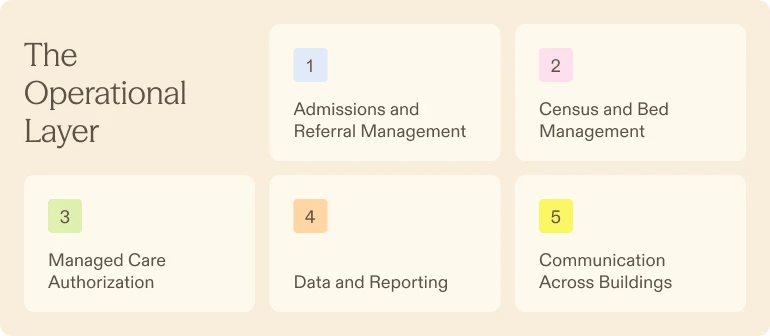
Admissions and referral management
This is the biggest gap. Once a referral arrives through one of those portals, someone has to read the full packet (often 50 to 100 pages of clinical documentation), check the patient's insurance, verify that the facility can handle the clinical needs, cross-reference against available beds, and communicate the decision back.
In a large percentage of facilities, this entire process runs on manual review, phone calls, and institutional knowledge. The dominant "technology" for intake at most SNFs is still a combination of spreadsheets, email, and the PCC CRM, which most operators describe as limited.
Census and bed management
Real-time bed availability is surprisingly hard to come by in skilled nursing. Many facilities track beds on a whiteboard, a shared spreadsheet, or a daily printed census report. For multi-facility operators trying to route patients to the right building, the lack of real-time capacity data creates delays and mismatches.
Managed care authorization
Prior authorization for managed care patients, particularly Medicare Advantage, is one of the most time-intensive workflows in an SNF. It involves interpreting payer contracts, pulling the right clinical documentation, submitting to payer portals (Availity, naviHealth (now Optum), Carelon, and a growing list of others), and tracking re-authorization deadlines.
Most operators manage four to eight separate payer portals for this process alone, and the work is almost entirely manual. At some organizations, a single person spends 30 minutes or more per referral on insurance verification before a clinical decision is even made.
Data and reporting
Most operators rely on their EHR's native reports for operational visibility, and most describe those reports as limited and difficult to customize. The analytics layer functionally doesn't exist as a commercial category for most SNF operators. Some build custom dashboards in Power BI. Some export data to Excel. Some have no systematic way to track referral conversion rates, decline reasons, response times, or payer mix across facilities.
Communication across buildings
For organizations with multiple facilities, the coordination between a central intake function and individual buildings often lives in email threads, group texts, or phone calls. Information gets lost. Context gets dropped. The speed advantage that central intake is supposed to create gets eroded by the tools, or lack of tools, that sit between the decision-makers.
How AI is filling the operational gap
The gap described above has existed for years. What's changed is that a new generation of purpose-built tools is emerging to fill it, and AI is accelerating the shift.
Where AI has the most impact
AI is entering the SNF tech stack not through clinical documentation, where EHRs are already deeply embedded, but through the operational workflows that were historically too unstructured for traditional software to handle:
- Referral packet review
- Insurance verification
- Clinical screening against facility-specific rules
- Managed care pre-authorization
These are the workflows where AI has the most immediate, measurable impact, because they involve reading large volumes of unstructured documents and applying complex, facility-specific logic under time pressure.
The right kind of consolidation
Operators don't want ten more logins. But they also don't want a single platform that tries to do everything and does most of it poorly. That frustration is increasingly common as EHR vendors push add-on modules into territory they weren't designed for, selling "platform consolidation" that only works when the platform can actually do the thing well.
The reality is that most operators are fine using multiple tools, as long as each one is excellent
at its specific job and integrates cleanly with the rest of the stack. Specialized reimbursement tools, care coordination platforms, and pharmacy analytics all have a place when they do their one thing better than the EHR can.
What's working is purpose-built tools for specific operational layers that integrate deeply with the EHR and referral portals the facility already uses. The goal isn't to replace PointClickCare. It's to fill the gap between the referral portals and the EHR, the operational layer where admissions decisions, reimbursement optimization, and census management actually happen.
Why this is a competitive differentiator
For multi-facility operators, especially, closing this gap changes outcomes. The organizations that can respond to referrals in minutes rather than hours, route patients to the right building based on real-time bed availability, and secure appropriate reimbursement levels from managed care payers on the first authorization. Those organizations win patients that their slower competitors are losing.
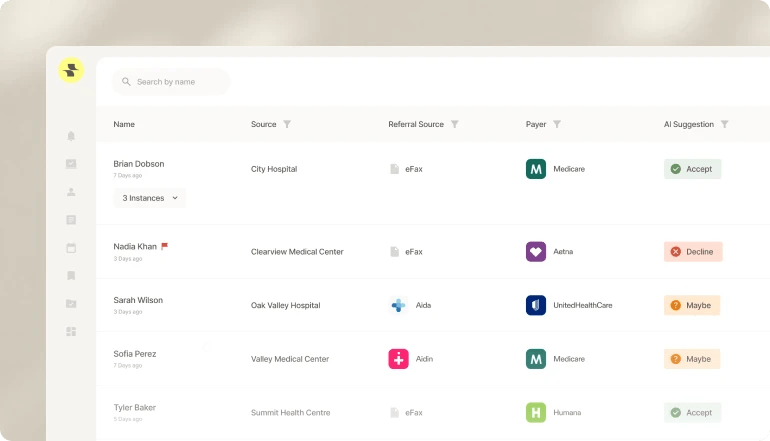
exacare ai was built specifically for this layer. The platform consolidates referral sources into a single queue, applies AI to read and screen referral packets against each facility's clinical and financial criteria, automates insurance verification, and provides portfolio-level visibility into admissions operations across every building.
exacare ai integrates with both PointClickCare and MatrixCare, connects to more referral platforms than any other tool in the space, and includes a Managed Care Agent that handles pre-authorization submission and level-of-care optimization. It's not a replacement for the EHR. It's the operational layer that sits in front of it. It is the system of action for teams, as opposed to the system of record.
What changes when you close the operational gap
The argument so far has been structural: the operational layer is missing from most SNF tech stacks, and the industry is starting to fill it. But structure only matters if it produces results. Here's what actually changes when facilities move from manual operational workflows to a unified system.
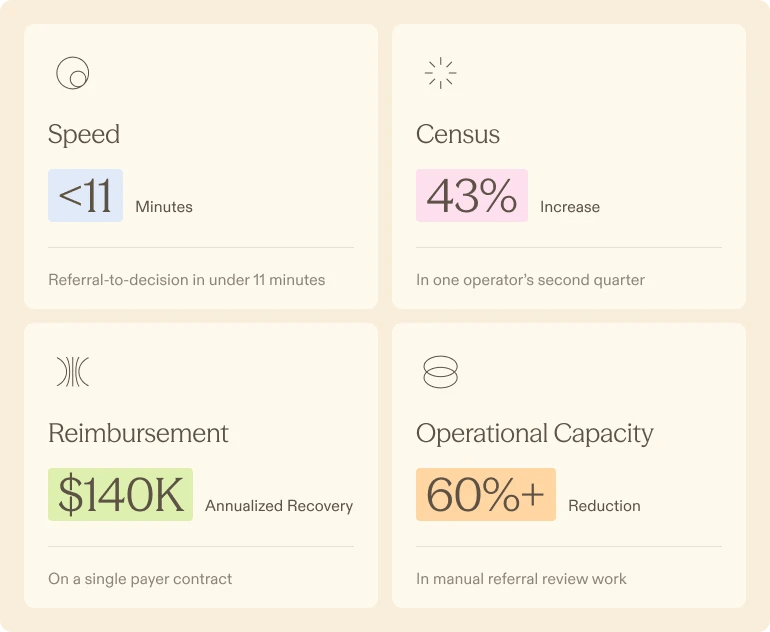
Speed: referral-to-decision in 11 minutes or less
Exacare ai's 2026 Time-To-Accept Benchmark Report, built on 256,719 referrals across 981 facilities, shows the top 10% of facilities holding a median time-to-accept of 11 minutes, including clinical screening, insurance verification, and risk flagging. The industry median is 30 minutes, and the fastest facilities are accepting in roughly 7.
Compare that to the 45 or more minutes teams historically spent just reviewing a referral packet, and the competitive impact becomes clear: in most markets, the first facility to respond with a confident answer wins the patient. In the benchmark data, each one-minute improvement in response time is worth roughly a 1% higher win rate, or about $125,000 a year for a 100-bed facility.
Census: 43% increase in one operator's second quarter
Pearl Healthcare, a 14-facility skilled nursing operator in Illinois, saw a 43% increase in census in their second quarter using exacare ai. Leadership attributed the growth directly to operational efficiency gains, not marketing changes. Their referral-to-admit win rate increased 2.6x, and 76% of referrals had a first review in under 20 minutes, up from 62% before implementation.
Reimbursement: $140K annualized recovery on a single payer contract
Managed care under-authorization is one of the most expensive problems in skilled nursing, and one of the least visible. One multi-facility operator using exacare ai's Managed Care Agent saw their share of Level 2+ authorized patients increase from 6% to 17% after implementation, with Level 2+ authorized days rising from 11% to 40%.
The financial impact on a single payer contract was approximately $140K annualized, and for the first time, the organization was securing Level 3 and Level 4 authorizations it had never previously obtained. The care impact matters as much as the financial one: higher authorization levels mean the facility is reimbursed to provide more physical therapy, occupational therapy, and nursing hours. The care those higher-acuity patients actually need.
See how Pearl Healthcare increased census by 43% across 14 facilities → Read the case study
How to figure out where your stack actually needs work
The sections above map the landscape. This one helps you figure out where to focus.
Identify the category first
Not every operator reading this has the same problem. The skilled nursing software landscape is broad, and the right investment depends on where your biggest operational bottleneck actually sits.
| Your biggest challenge | What you're evaluating | Where to start |
|---|---|---|
| Clinical documentation | Charting | MDS compliance | EHR platforms | PointClickCare, MatrixCare, Netsmart (covered above) |
| Shift coverage | Overtime | PBJ reporting | Staffing and scheduling | Smartlinx, OnShift/ShiftKey |
| Referral response time | Admissions decisions | Insurance verification | Portal fragmentation | Cross-building visibility | Managed care authorization | Census management and reporting | Operational layer/intake technology | exacare ai |
If you're evaluating the operational layer, here's what matters
For operators evaluating that operational layer, here's what to look for:
- Real integration, not just claimed integration: Every vendor says they integrate with your EHR. The question is whether that integration is real-time, bidirectional, and actually reduces the number of places your team has to enter data. If your staff still has to copy information from the new tool into PointClickCare manually, you haven't solved the two-system problem. You've added a third system.
- Built for post-acute care, not adapted from another setting: The referral workflows, payer dynamics, clinical screening criteria, and regulatory requirements in skilled nursing are specific. General healthcare tools adapted for SNFs consistently miss the nuances, from PDPM estimation to managed care contract interpretation to facility-specific admission rules that vary building by building.
- Consolidation of your referral sources: If your team is already toggling between six portals, the last thing they need is portal number seven. The tool should pull referrals from all of your sources (WellSky, Epic CareLink, Aidin, Ensocare, eFax, and others) into a single queue with a single workflow.
- Facility-specific clinical and financial criteria, applied automatically: Every building has different deal-breakers, different payer mixes, different bed configurations, different clinical capabilities. The tool needs to flex to those differences, not force you into a generic template that requires your team to manually adjust for every referral.
- Portfolio-level visibility: For multi-facility operators, the ability to see response times, conversion rates, census trends, decline reasons, and payer mix across the entire organization, in real time, is the difference between managing operations and guessing at them.
- Implementation reality: In post-acute care, the gap between what's promised during the sales process and what's delivered after the contract is signed can be wide. Ask about training timelines. Ask for references from operators your size. Ask what happens when something breaks at 7 AM on a Monday.
The SNF tech stack isn't fragmented because the individual tools are bad. PointClickCare does what it was designed to do. WellSky's referral portals work as intended. The pharmacy systems, billing platforms, and staffing tools each serve their function.
The fragmentation exists because nobody built the connective layer between them. The operational layer where admissions decisions, referral management, insurance verification, and census coordination actually happen.
For years, that work was done manually, and it was good enough. It's not good enough anymore. Response times matter more. Managed care complexity has increased. Referral volumes are rising. And the operators who've filled that gap are seeing measurable differences in speed, census, revenue, and operational excellence across their teams.
If you're evaluating your operational stack, exacare ai works with SNF operators across the country to close this gap. See it in action here →
FAQs
Share







Move your team forward
Move your team forward