

Steps in the SNF Referral Process: What Actually Happens (and Where It Breaks Down)


TL;DR
- The SNF referral process has seven steps: referral receipt, intake and triage, clinical review, insurance and financial verification, bed and staffing check, the admission decision, and communication and transfer coordination. On paper, they're sequential. In practice, they overlap, stall, and break in ways that cost facilities referrals they should be converting.
- Clinical review is the bottleneck. In most facilities, it runs entirely manually, takes far longer than it should, and produces inconsistent decisions because reviewers are searching 50 to 100+ page packets instead of deciding from them. Across roughly 825 facilities on exacare ai, the top 10% reach a final accept-or-decline decision in 7.1 minutes on average, and the top 25% in under 11 minutes.
- Higher-converting facilities aren't getting better referrals; they're running a faster, more consistent process on the same ones. Pearl Healthcare attributed a 43% census increase in their second quarter using exacare ai to operational efficiency, with no marketing changes.
The steps in the SNF referral process aren't a mystery. If you've worked intake in a skilled nursing facility, you can recite them in your sleep. A referral comes in. Somebody triages it. Somebody reads the chart. Somebody checks insurance. Somebody confirms the bed. Somebody calls the hospital back with an answer. That's the process on paper.
What's harder to talk about is what happens between those steps:
- Clinical reviews that run past 40 minutes
- Referrals that sit in a portal for hours before anyone opens them
- Accept-or-decline decisions that vary depending on who's on shift
- Hospitals that stop sending after a few slow responses
What follows are the seven steps from the operator's view, but we name where each step actually breaks, because that's where the referrals you should be converting are getting lost.
The 7 steps in the SNF referral process
Before going deep on each one, here's the full sequence:
- Referral receipt: the referral arrives from a hospital, physician, or other source.
- Initial intake and triage: the referral is logged, checked for completeness, and prioritized.
- Clinical review: a clinical team member assesses whether the facility can safely care for the patient.
- Insurance and financial verification: the team confirms coverage, benefits, and authorization requirements.
- Bed availability and staffing check: the facility confirms it has the right bed and the right coverage.
- The admission decision: the facility accepts, declines, or asks for more information.
- Communication and transfer coordination: the decision is communicated back, and the transfer is scheduled.

On paper, these are sequential. In practice, they overlap, get skipped, or stall depending on staffing, volume, and how the facility manages intake. They also look very different depending on whether the organization runs a central intake model or facility-level intake. With that map in hand, here's what each step actually looks like.
1. Referral receipt
This is where the process starts and where fragmentation begins.
Referrals come from a wide range of healthcare providers: hospital discharge planners and case managers, physician offices, health systems, other post-acute facilities, and referral networks like WellSky CarePort, Aidin, and naviHealth (now part of Optum). Most SNFs receive referrals across three to five platforms at minimum, plus fax, plus phone, plus email. There is no single inbox.
A typical referral packet includes a hospital discharge summary, physician orders, current medication list, insurance information, recent labs, and therapy notes. The exact contents vary by source, by hospital, and sometimes by who hit "send."
Where it breaks
Referrals arrive in different formats across different channels, and if nobody is monitoring all sources in real time, they sit. Every hour of delay is a competitive disadvantage, because hospitals send to multiple facilities simultaneously and place with whoever responds first. The team that's checking five portals manually throughout the day is structurally slower than the team that has every referral landing in one place. For a deeper look at that consolidation problem, see our piece on AI-powered referral packet ingestion.
2. Initial intake and triage
This is the first human decision point, and it's where speed either compounds or costs you.
The intake coordinator logs the referral, confirms it's complete enough to review, assigns urgency, and routes it to the right clinical reviewer. Urgency matters: emergency discharges, urgent placements, and routine referrals need different response cadences. Most facilities don't formalize that distinction, which means everything gets treated with the same baseline urgency until someone decides otherwise.
Completeness is the other piece. Are the medical records there? Is the insurance information attached? If something is missing, it should be flagged immediately and chased down, not discovered 25 minutes into a clinical review.
Where it breaks
There's no standardized triage criteria in most buildings. Intake is whoever picks up the phone or notices the portal first. Incomplete referrals don't get flagged until someone is deep into clinical review and realizes the discharge summary is missing or the medication list is from two admissions ago. Many of the operators we've talked with target a 15-minute response time on every referral, but very few are hitting it consistently.
3. Clinical review
This is the most time-intensive and highest-stakes step in the entire process. It's also the step where the difference between fast facilities and slow facilities is most visible.
A clinical team member, typically the DON, ADON, or a designated clinical reviewer, reads through the referral packet to assess whether the facility can safely and appropriately care for the patient. They're evaluating diagnoses, current medications, behavioral history, therapy needs, wound care requirements, and any clinical red flags. The question they're trying to answer is straightforward: can we manage this patient's acuity with the staffing, equipment, and services we have right now?
The trouble is the documentation:
- Referral packets routinely run 50 to 100+ pages
- The critical clinical details are buried across discharge summaries, progress notes, medication administration records, and therapy evaluations
- Behavioral history in particular tends to be hidden or softened. A patient described as having "no behaviors" in the hospital chart may have been on a sitter, in soft restraints, or receiving PRN antipsychotics throughout the stay
- High-cost medications can sit on page 73 of a med list and never get flagged until pharmacy raises it after admission.
Where it breaks
In many facilities, this step alone runs well past 30 minutes per referral, and operators we've talked with routinely describe reviews that stretch to 45 minutes or more when the packet is dense. The clinical reviewer is often a DON who is also managing the floor. The review is entirely manual. And because the assessment is filtered through individual judgment, two reviewers looking at the same chart can reach different conclusions about clinical fit.
This is the step where the operators getting ahead are doing something different. Pearl Healthcare, a 15-facility operator in the Chicago area, now reviews 76% of referrals in under 20 minutes using exacare ai's Admissions Screener, up from 62% before. A 50-facility post-acute operator we've worked with cut average referral review time by 45%, moving from 40+ minutes per referral to 89% of referrals reviewed in under 22 minutes.
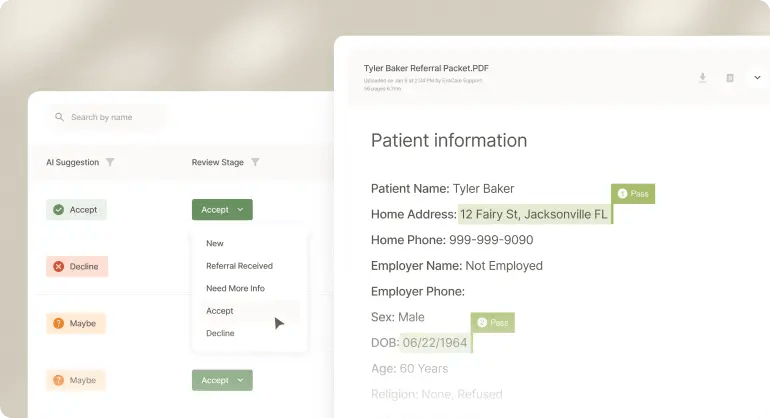
In both cases, the change wasn't about making clinical reviewers work faster. It was about putting the relevant clinical flags, medication risks, and behavioral history in front of them on page one, so they spent their time deciding instead of searching.
This compression matters because the clinical review bottleneck is what slows the rest of the process. Move it from 45 minutes to under 20, and everything downstream moves with it. (We go deeper on that conversion math in how to increase admissions in a nursing home.)
4. Insurance and financial verification
This step typically runs in parallel with clinical review, but it's where the longest delays usually live.
The admissions or case management team verifies the patient's insurance coverage, checks authorization requirements, confirms benefit eligibility, and identifies the expected payer: Medicare, Medicaid, managed care, private.
Payer mix matters operationally because it directly affects whether the admission is financially sustainable for the facility. Managed care, in particular, introduces both delay and complexity, because authorization workflows vary by plan and timelines are unpredictable.
Where it breaks
Insurance verification is still manual in most facilities. Staff are logging into payer portals one at a time, calling insurance companies, and waiting on hold. Authorization timelines vary wildly by payer. Managed care pre-auth can take hours to days, and the referral source is not waiting around for an answer.
Verification work that happens after the clinical decision adds time that the facility doesn't have. Verification work that happens before the clinical decision burns staff hours on referrals that the facility may not even take.
5. Bed availability and staffing check
This is the operational reality check. Even a clinically appropriate, financially viable referral can't convert if the bed or the staffing aren't there.
The team confirms bed availability (right unit, right room type), checks current staffing levels against the patient's acuity, and confirms that therapy and rehabilitation services can be scheduled within the expected admission window.
Where it breaks
Bed availability is often tracked informally, on a whiteboard, in a spreadsheet, or by walking down the hall to ask the charge nurse. In multi-facility organizations, there's no real-time visibility across buildings. A referral can get declined at one facility while another facility in the same organization has an open bed and the right staffing for that exact patient. The decline isn't wrong at the building level. It's just expensive at the portfolio level.
6. The admission decision
This is the step everything else has been building to. Based on the clinical review, the insurance verification, and the bed and staffing check, the facility accepts, declines, or asks for additional information. In some organizations, that decision is made at the facility level by the admissions director or DON. In others, it's made or validated by a central intake team.
A decline isn't always permanent. Facilities often decline for fixable reasons (missing documentation, unverified insurance, a clinical flag that turns out to be a documentation error) without communicating that clearly to the referral source. A "no" that should have been a "not yet" gets coded as a lost referral.
It's also worth noting: Different buildings within the same operator legitimately have different admission criteria, because they have different capabilities. A building with dialysis can take patients a building without dialysis can't. A building with a vent unit, a memory care wing, or a behavioral health program will accept clinical profiles that other buildings in the same portfolio won't. That's not inconsistency. That's capability matching, and it's correct.
The real consistency problem shows up when two buildings with the same capabilities reach different decisions on similar patient profiles, because the decision is filtered through individual reviewer judgment instead of standardized screening criteria. One DON weighs behavioral flags more conservatively than another. One reviewer is sensitive to medication complexity, another to wound care. The decision becomes feelings-based rather than criteria-based, and leadership has no visibility into why.
Where it breaks
There's no audit trail on decline reasons, no aggregate data to identify patterns ("we're declining 20% of referrals for a clinical reason we could actually manage with a small staffing change"), and no way for leadership to use that data strategically: adding service lines, adjusting payer strategy, coaching reviewers, revisiting admissions policies.
The 50-facility operator we mentioned earlier discovered that roughly 20% of their referrals were bypassing central intake entirely before they consolidated everything into a single platform. Their Director of Central Intake described what changed afterward as taking everyone's "feelings about a referral" out of the equation and turning the decision into a consistent matrix across buildings.
For more on the central intake operating model and how it differs from facility-level intake, read “What Is Central Intake in Post-Acute Care?”
7. Communication and transfer coordination
The referral process doesn't end at the decision. The last step is closing the loop.
The facility communicates the decision back to the referral source (hospital discharge planner, case manager, referring physician).
- If the answer is yes, the team coordinates the transfer: confirms admission date and time, arranges transportation, prepares the room, notifies nursing and therapy teams, and gathers any remaining admission paperwork.
- If the answer is no, the facility ideally communicates the reason clearly enough that the hospital knows whether to come back with a different patient or never to send to that building again.
Where it breaks
Communication back to the referral source is slow or inconsistent. Hospitals are calling to find out where their referral stands. If the facility takes too long to respond, the hospital simply moves to the next option on the list, and the bed goes elsewhere. Speed of communication ends up being almost as important as the decision itself, because hospitals remember which facilities respond and which ones don't.
Where the process breaks down (and what it actually costs)
Reading through the seven steps, the breakdowns can look like isolated problems. A slow portal here. A long clinical review there. A manual insurance check. An informal bed tracker. The reality is they don't show up in isolation. They compound.
A referral that sits in a portal for two hours, then takes 45 minutes to clinically review, then waits another hour for insurance verification, then needs a bed availability check that requires three phone calls, isn't a fast process with one slow step. It's a slow process at every step. By the time the facility responds, the hospital has already placed the patient elsewhere. The referral wasn't lost at any single moment. It was lost cumulatively.
The cost of that compounding is real, and it's measurable. Every referral lost to slow response time is a bed-day not filled. For a Medicare A patient, that's significant daily revenue. Across a month, across a portfolio, across a year, the revenue impact is material. And it's recurring, because the hospitals that stop sending you patients don't usually start again on their own.
The operators converting at higher rates aren't getting better referrals. They're running a faster, more consistent process on the same referrals everyone else is receiving. Pearl Healthcare attributed a 43% census increase in their second quarter (using exacare ai) to improved process efficiency, not to new referral sources or marketing changes. Their VP of Business Development was direct about it: the change was operational.
The steps in the SNF referral process aren't complicated. What's complicated is running them fast enough, consistently enough, and across enough volume to convert the referrals you're already receiving. Most facilities know what to do at each step. The gap is in how fast and how consistently they do it.
exacare ai helps SNFs consolidate referrals into a single workflow and compress clinical review time across the intake process. Learn more about how it works.
FAQs
Share







Move your team forward
Move your team forward