

Referral Management Software for Healthcare: What Post-Acute Operators Actually Need


TL;DR
- Most referral management software is built for the acute and ambulatory referral loop (a primary care physician refers to a specialist, the software tracks the order and closes the loop). Post-acute operators face a different problem entirely: consolidating inbound referrals from multiple hospital portals, screening them clinically at speed, and responding before the bed goes to the facility down the road.
- The right evaluation criteria for post-acute referral management are portal consolidation, clinical screening depth, response time visibility, multi-facility reporting, and managed care capability. Most platforms marketed as "referral management software" don't address any of these.
- Exacare ai is purpose-built for post-acute referral management. Across 2,000+ facilities and 2M+ referrals reviewed, the platform consolidates referral data from every source, applies facility-specific clinical rules, and gives operators portfolio-level visibility into intake performance.
Most software marketed as "referral management" is built for one workflow: a primary care physician refers a patient to a specialist, the software tracks the order, and the loop eventually closes. Phreesia, Luma Health, Dock Health, and HealthViewX all live in that world. It's a real problem worth solving. But it's not the problem post-acute operators have.
A skilled nursing operator managing inbound referrals from four hospital portals and an eFax inbox needs something fundamentally different, and very little of the public information online walks through what to look for. That's what this piece is for.
What referral management software actually does
Referral management software helps healthcare organizations receive, route, screen, and act on patient referrals. That definition is broad on purpose, because the term covers two very different operational realities depending on where you sit in the care continuum:
1. Acute and ambulatory referral management
A primary care physician refers a patient to a specialist. Software tracks the referral order, confirms scheduling, sends reminders, and closes the loop. The core problem being solved is referral leakage: patients dropping out of the system between the order and the appointment. This is what Phreesia, Luma Health, Dock Health, HealthViewX, and most of the well-known platforms in this category are built for.
2. Post-acute referral management
Hospital discharge planners send referrals through portals (WellSky, EpicCare Link, Aidin, ABOUT Ensocare, CarePort, and others), through fax, and sometimes through email. The receiving operator (a skilled nursing facility, home health agency, or hospice) needs to pull all of those referrals into one place, screen them clinically against facility-specific criteria, verify insurance, and respond faster than the facility down the road. The core problem is fragmentation, speed, and clinical risk at volume.
Most of the software on the market was designed for the first scenario. We'll focus on the second, because that's where the operational complexity is highest, the stakes are most concrete, and the tooling gap is widest. It's also the space exacare ai was built for, which is why we have a point of view on it worth sharing.
Why post-acute referral management is a different problem
Before evaluating any software, it helps to be precise about what the work actually looks like in a post-acute building today.
A typical mid-sized skilled nursing operator manages four to ten inbound referral portals at the same time and:
- Operators don't get to choose which portals they use: The portals are assigned by the hospitals and health systems sending the referrals, which means a single facility might be logging into WellSky for one health system, Aidin for another, EpicCare Link for a third, and watching an eFax inbox for the rest.
- There is no single platform that aggregates all of them, and switching costs for the upstream hospital are essentially zero, so the fragmentation isn't going away on its own.
- Inside each portal, the screening process is manual and high-stakes: A referral packet routinely runs 50 to 100+ pages. A clinical reviewer has to scroll through the medical record, check clinical flags, run sex offender database checks, look at medication history (and the cost of those medications), verify insurance, and compare everything against the facility's specific admissions criteria. In most buildings, the best case is 40 minutes from the referral landing to a decision going back out. The realistic case is longer.
- Speed is the competitive differentiator in this market: Most hospitals give the bed to the first facility that can give a confident yes. The top-performing operators we work with have explicit response time targets in the 10 to 15 minute range, and they treat anything slower as lost revenue. If your team can't see how long a referral has been sitting in queue, you are losing beds you could have filled.
- There is a huge visibility problem: For any operator running more than a handful of buildings, regional and executive leadership needs a cross-facility view: how many referrals are pending, why they're pending, which facilities are deciding quickly, and where capacity is open. Without that, leadership is reduced to calling buildings one by one and asking. Most operators we talk to are doing exactly that.
Broken down step by step, the post-acute intake workflow looks like this, and so does the realistic line between what software should be handling and what still requires a human in the loop:
| Intake step | What good software should handle | What still requires human judgment |
|---|---|---|
| Receive referral from portal, fax, or email | Fully automated ingestion from every source | None |
| Extract patient information into structured fields | Fully automated, including documents and patient history | None |
| Verify insurance and benefits | Fully automated | Occasional spot-check on edge cases |
| Apply facility-specific clinical screening rules | Generates a recommendation with supporting evidence | Clinical reviewer verifies and signs off |
| Make the final accept-or-decline decision | Surfaces the recommendation; doesn't decide | Clinical reviewer makes the call |
| Assign the patient to a specific facility (for multi-site operators) | Surfaces capacity and specialty fit | Admissions manager makes the call based on census, specialty, and geography |
| Communicate the decision back to the referral source | Fully automated with secure messaging | None |
| Push patient data into the EHR for admission | Fully automated push to the facility EHR | None |
The pattern is clear: most of the steps in the intake workflow can and should be automated. The places where human judgment still matters are concentrated in two decisions, the clinical accept/decline call and the facility assignment for multi-site operators. Any vendor whose automation stops short of this standard is leaving work on your team's plate that doesn't need to be there.
This is the operational reality the software needs to solve, and it's the reality exacare ai was built around from day one. The evaluation criteria below come directly from these problems.
What to look for when you're evaluating referral management software
The criteria below come directly from the operational reality above. They're ordered roughly by how often they're the deal-breaker in evaluations we've seen: portal coverage tends to be the first thing that disqualifies a vendor, and implementation quality tends to be the last thing operators wish they'd weighted more heavily.
Portal consolidation
The first question isn't "does it integrate with our EHR?" It's "does it pull referrals from every source we receive into one place, so my team stops toggling between portals?"
Ask the vendor for a list of every portal they connect to. If your top three referral sources aren't on it, the tool will not solve your core problem, no matter how good the rest of it is. Be especially careful with vendors whose "consolidation" only works inside their own referral network. If the platform can't ingest referrals from the portals your hospitals actually use, it isn't solving the fragmentation problem; it's just adding another inbox to the ones your team is already checking.
Clinical screening depth
Can the software apply your facility-specific admissions criteria to incoming referrals automatically?
Generic AI summaries are not the same thing as configurable clinical screening. The bar to set is whether the system flags:
- Diagnosis exclusions
- Acuity thresholds
- Insurance requirements
- Sex offender hits
- Medication cost outliers based on rules your team defines
And then surfaces a recommendation with supporting evidence the clinical reviewer can verify. The goal is that your clinical team reviews a recommendation, not a raw stack of patient documents.
EHR integration depth (the two-system problem)
A common failure pattern in this category is the two-system problem: operators end up maintaining one system for referral review and a second for the clinical record, with staff manually re-entering information between them.
Ask specifically what data the referral management platform pushes into your EHR, in what format, and whether it requires manual intervention. If the answer is vague, you are buying yourself a second system, not solving for the one you have.
Response time visibility
If your team can't see how long a referral has been sitting, you can't manage to a response time target.
Look for real-time tracking of referral status, time-to-first-review, time-to-final-decision, and alerting when referrals age past your threshold. This should exist at the individual facility level and at the portfolio level.
Multi-facility and portfolio visibility
This is where most operators feel the pain inflect somewhere between 5 and 15 facilities. Below that, a regional director can keep tabs on every building with a phone call or two. Above it, that approach quietly stops working: by the time you've finished checking in on facility 12, the referrals at facility 1 have moved on.
Software needs to give regional and executive leadership a true cross-portfolio view of which facilities are reviewing quickly, which are letting referrals sit, and where capacity is open. This is the difference between facility-level software and an operating system for intake. If the only reporting available is at the building level, you are still going to be calling facilities one by one.
Managed care capability
Managed Medicare is growing as a share of post-acute admissions, and authorization complexity is growing with it. If the software doesn't help you navigate pre-authorization, reimbursement estimation, or payer-specific requirements, you will be bolting on another tool inside of a year.
Ask whether managed care workflows are part of the product or a separate add-on, and ask whether the vendor can quantify the time savings they're delivering on prior auth.
Implementation and support reality
Post-acute teams have been burned by vendors who sold well and supported badly. Ask about dedicated implementation, training timelines, and what happens when something breaks. Talk to operator references who have been live for at least 90 days, not just ones who finished onboarding last week.
How exacare ai approaches referral management for post-acute care
exacare ai is built specifically for the post-acute corridor described above. The platform consolidates referral data from every portal, fax, and email into a single system, so admissions teams stop toggling between hospital portals and start working from one queue. Live integrations include WellSky, EpicCare Link, Aidin, CarePort, ABOUT Ensocare, and others.
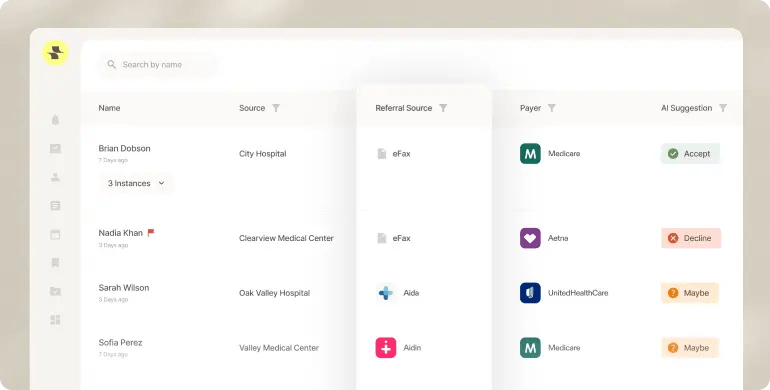
Inside that consolidated view, the Admissions Screener applies facility-specific clinical rules to every referral automatically. Diagnosis exclusions, acuity thresholds, insurance requirements, sex offender checks, and medication cost flags are all configurable during onboarding, so the clinical team reviews a recommendation with supporting evidence rather than a raw 50-page packet. A dedicated ML engineering team is behind the models, with backgrounds from Amazon, Tesla, and Google.
Response time tracking is built into the platform at both the facility and portfolio level, so leadership can see exactly how long referrals have been sitting and where the bottlenecks are. In our 2026 Time-To-Accept Benchmark Report, built on more than 250,000 referrals, the fastest 10% of facilities reached a decision in 11 minutes or less and the top quartile in 17, against an industry median of 30.
Success stories
- Pearl Healthcare, a 15-facility skilled nursing operator, saw a 43% census increase in their second quarter on exacare ai and a 2.6x increase in referral-to-admit win rate. Pearl's leadership attributed the gains to operational efficiency, not to changes in marketing or business development.
- A 50-facility Midwestern post-acute operator reduced average referral review time by 45%, increased monthly referral volume by 60%, and doubled intake capacity for their central team.
The post-acute referral management category is young and moving fast. Two years ago, most of the platforms operators are now evaluating either didn't exist or looked very different. The bar is rising quickly, which is good news for operators: the gap between "doing this with a spreadsheet" and "doing this with the right system" is wider every quarter.
If you're evaluating referral management software for your facilities, exacare ai works with skilled nursing operators across the country. You can see a demo or talk to our team.
FAQs
Share







Move your team forward
Move your team forward